Your Costs Are Going Up. What About Your Care Fees?

Your care business may be generating more income than ever. But is it making the profit it should be?
In our first November article, we looked at the Autumn Budget, and the additional costs you will face from April 2027.
I also asked how much have the cost increases of previous years already affected your profitability?
I asked the question because in previous talks in recent years, especially after my “Beyond Survival: How to Prepare for April’s Cost Rises” webinars, I’ve asked care providers if they reviewed their fees, arranged client review meetings and successfully negotiated fee increases.
Very few raised their hands and that concerned me because I know that those who didn’t negotiate higher fees will have seen a major cost rise with no increase in revenue, beyond whatever annual uplift they received. And where those uplifts fell short, the difference had to be absorbed by their businesses — and ultimately their profits.
So, April coming won’t necessarily be the beginning of the problem. And for some providers, it's going to be another increase on top of several years of rising costs that haven't been fully reflected in their care fees.
And that’s just wage rises, never mind the continuously increasing costs of essentials like food and energy.
And so, as I start to do each year around this time – I have to ask if the fees you're receiving genuinely cover the cost of delivering care and provide the profit your business needs to remain financially healthy.
I know, this makes many care providers uncomfortable. I also know fee negotiations can be difficult and that many providers feel they have little influence over what commissioners are prepared to pay. And some are understandably reluctant to challenge an offer because they don't want to risk damaging relationships or losing placements.
And I understand all that.
But here's where I have to challenge that thinking.
Your first responsibility is to protect the financial health and future of your care business.
Of course, maintaining good relationships with commissioners is important. But not at the expense of continuing to provide care at fees that are financially unsustainable.
I've seen too many care providers put off difficult fee conversations, sometimes for years, while their financial position continued to deteriorate.
And for some, the consequences have been devastating. Care businesses have closed, and providers have faced insolvency.
This isn't a new problem. Back in 2017, research found that care homes were the only UK industry to have experienced rising insolvency numbers over the preceding seven years.
And the problem hasn't gone away. Figures from the Insolvency Service show that 97 residential care companies became insolvent in England and Wales in 2025, compared with 58 the previous year.
The Guardian — Care home insolvencies, May 2017
2026 analysis of care-sector insolvency figures
So, I make no apology for being direct about this.
If your fees are no longer covering your costs and providing the profit your business needs, can you really afford not to challenge them?
Because ultimately, protecting a relationship with a commissioner won't count for much if there's no business left to protect.
An annual uplift isn't a proper fee increase
Let’s put this conversation to bed.
A commissioner may offer an annual uplift of, say, 3%. Of course, that’s welcome but what does that 3% actually represent?
Is it based on your real costs? Does it reflect the needs of the people you're supporting? Does it account for changes in staffing, operating expenses and the level of profit required to sustain your service?
Or is it simply a percentage applied to last year's fee? Because if last year's fee was already inadequate, increasing it by 3% doesn't necessarily solve the problem.
It might simply mean you're being paid a little more to continue losing money.
And even if you're still making a profit, it might be considerably less than your business needs.
An annual uplift isn't the same as establishing whether the fee itself is right.
The gradual erosion of profit
If costs have increased faster than your fees for several years, the consequences can be significant.
Imagine a care business three years - three April cost rises - ago was generating £1 million in annual fee income with operating costs of £900,000.
That's a £100,000 operating profit — a 10% margin.
Now imagine that, over the following few years, operating costs increase by 15% - a realistic figure as you’ll know if you’ve been following my annual cost increase calculations and webinars - while fee income increases by approximately 5% over the same period.
Assuming the volume and mix of care remain unchanged, annual costs rise to £1,035,000 and fee income rises to £1,050,000.
The business is still profitable.
But only just.
Its operating profit has fallen from £100,000 to £15,000.
That's £85,000 less annual profit, despite income having increased.
And its operating profit margin has fallen from 10% to approximately 1.4%.
These illustrative, but realistic, figures, demonstrate something I think every care business owner should understand.
You could be running a business that's just as busy, perhaps even generating more income than you were a few years ago but making considerably less money.
And the worrying part?
That reduction in profit may have happened gradually, without you fully appreciating the extent of it.
And then another round of cost increases comes along like the ones we're facing next April. As you see, simply securing an increase to cover those additional costs won't necessarily recover the profit you've already lost.
A business can be earning more money and becoming less financially healthy at the same time.
And this is why I keep encouraging care providers to review their fees rather than simply accepting whatever annual uplift they're offered.
I've seen too many providers put off these difficult conversations until their financial position became critical. Some care businesses have ultimately had no choice but to close, while others have faced the prospect of insolvency.
I don't want to see more providers heading in that direction.
So here's the uncomfortable truth with no apology for repeating myself.
If your care fees haven't kept pace with your costs for several years, the choice may no longer be whether you want to negotiate higher fees. It may be whether you negotiate the fees your business needs or risk its future.
That might sound harsh but ignoring the problem won't make it go away.
What might this mean for your care business?
Now, I'm not suggesting every provider has experienced the same level of profit erosion as the business in our example. Some will have managed costs effectively, negotiated appropriate fees and maintained healthy margins.
But here's the important question. Do you actually know?
When did you last compare how your costs have increased against the fee increases you've received from successful negotiations and uplifts?
And how confident are you that your current profit margin is where it should be?
You don't need to spend days analysing spreadsheets to begin answering those questions because I've developed something to help you take that first step.
Introducing the Profit Health Check
We’ve developed a free Profit Health Check to help care providers get an initial indication of how changes in operating costs and fee income may have affected their profitability over time.
Using a few key financial figures, it helps you explore what may have happened to your profit margin and consider the potential impact of further cost increases.
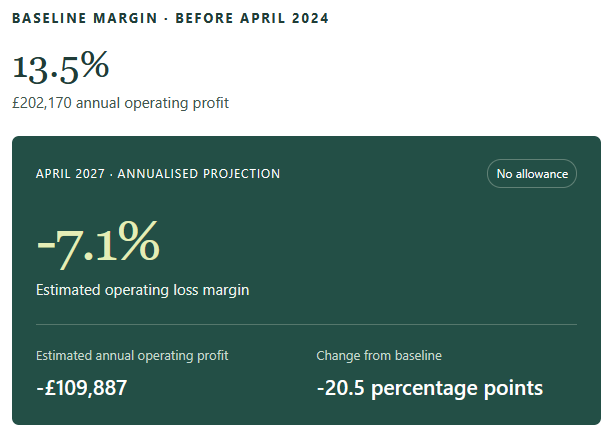
And it only takes around three minutes to complete.
It's not a detailed financial assessment, and it won't tell you exactly what fees you should be charging individual clients. (You know I have tools that will do that.)
But it can help you understand what may have been happening to your profit margin in recent years and recognise whether there's something you need to investigate further.
That’s a vital first step.
Try the free Profit Health Check
Do you know which clients are profitable?
Understanding your overall financial position is important.
But that’s just the start. What you really need to know is which clients are returning the profit your business needs and which are being subsidised by those who are. And, as operating costs continue to rise, the room for absorbing those loss-making clients becomes smaller.
And this is where understanding your overall profitability is only part of the picture.
You need to understand whether the fees you're receiving for individual clients genuinely reflect the cost of their care.
Negotiation needs evidence
Let's recognise that commissioners are under considerable financial pressure themselves, and individual fee reviews aren't necessarily conversations they're eager to have.
They may use benchmarking tools such as CareCubed when assessing the fees they're prepared to pay.
But a benchmark isn't necessarily the actual cost of delivering care to a particular individual in your service.
And if you're challenging a fee because the person's needs require more resources than the benchmark allows for, you need to be able to demonstrate why.
Without that evidence, you're going to have a very difficult time persuading a commissioner to agree to a higher fee.
Providers should be confident about challenging fees that don't reflect the real cost of delivering care. But confidence needs to be supported by evidence.
Simply telling a commissioner that your costs have increased isn't particularly persuasive. Every provider is facing cost pressures, and commissioners have their own financial constraints.
Being able to demonstrate your actual costs, explain the staffing and resources required for an individual client and show how you've calculated a sustainable fee is a different conversation.
It doesn't guarantee that a commissioner will agree to your request.
But it gives you a far stronger position from which to negotiate.
And it helps you understand when an offer is financially viable and when it isn't.
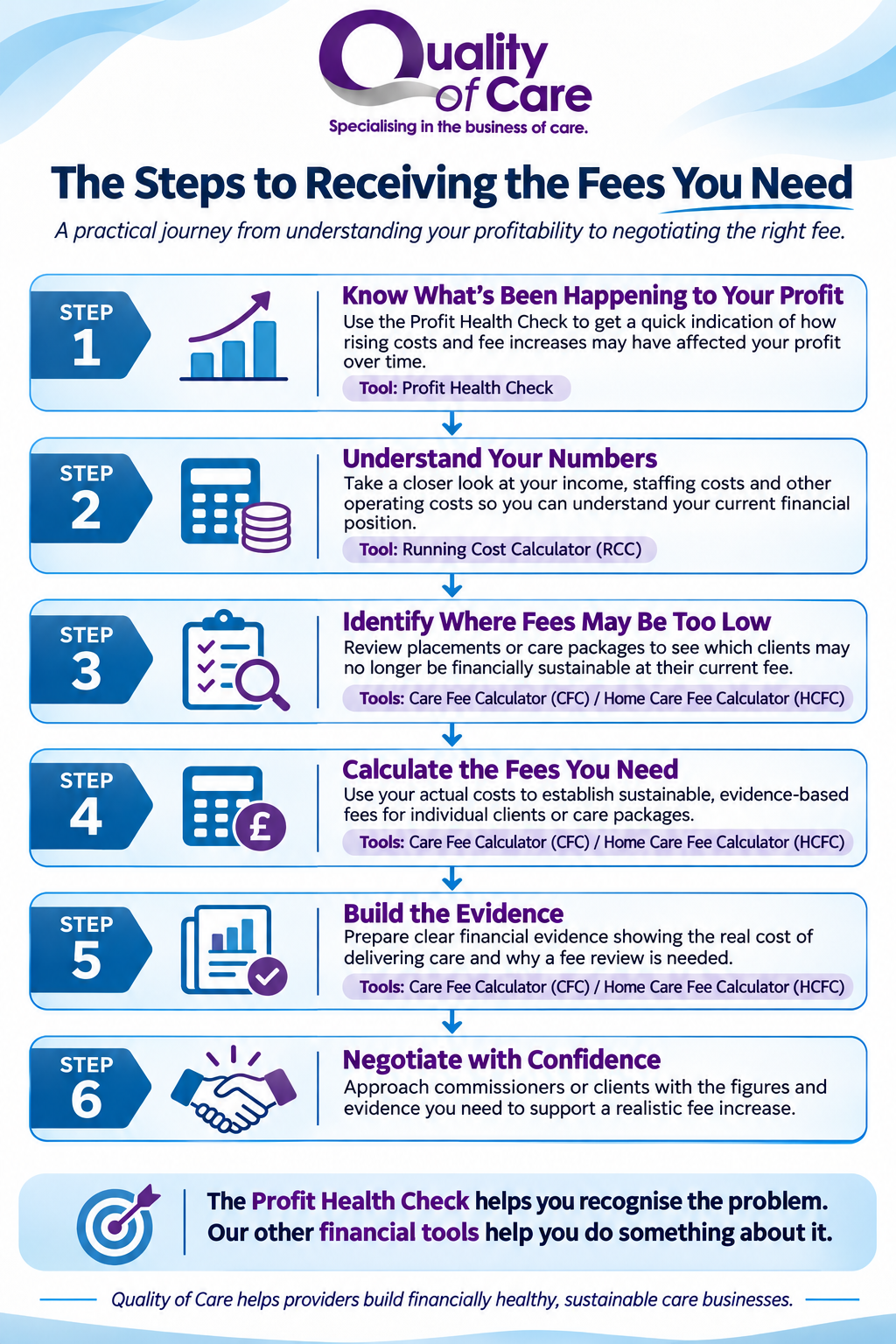
This is also where more detailed financial tools, including our Running Cost Calculator, Care Fee Calculator and Home Care Fee Calculator, can help providers move beyond understanding their overall financial position to calculating and evidencing the fees they actually need.
Don't wait for someone else to decide
April's wage increases are coming whether your fees are ready or not. And as we discussed in our first November article, the real deadline is much sooner than April.
If your fees need reviewing, you should be aiming to have your calculations completed and your supporting evidence prepared by the end of February.
That gives you time to approach commissioners and begin negotiating before the new costs take effect.
But you don't have to tackle everything today.
Start by establishing whether your business is as financially healthy as you think it is.
That's why we've introduced the Profit Health Check.
It's a simple first step towards understanding where you stand and whether further action might be needed. And if you discover that your business needs a closer look, we want to help you take those next steps too.
Understanding whether your profits have been eroded is the first step. Knowing what to do about it is the next.
Our Profit Health Check can help you identify where there may be a problem, while our financial management tools help you understand your costs, calculate sustainable fees and build the evidence needed for negotiations.
And if you'd like some guidance along the way, we're developing a Financial Health Programme to help providers work through this journey, step by step.
You'll have the opportunity to register your interest after completing the Profit Health Check.
You don't have to work everything out on your own.
The Profit Health Check helps you recognise the problem. The Financial Health Programme will help you do something about it.
You may not control the decisions commissioners make.
But you can control how well you understand your costs, how you calculate your fees and the evidence you take into negotiations.
Quality of Care helps care providers build financially healthy, sustainable businesses through better cost control, accurate fee calculations and practical financial management tools. Our Care Fee Calculator and Home Care Fee Calculator help providers understand the real cost of delivering care and prepare evidence-based fees for individual clients.


Products

Home Care Fee Calculator