The Overwhelming Challenge of Staff Training in Social Care and Why a Central Training Management System is Now Essential
Your organisation revolves around the quality of the service you deliver. Whether directly delivering care or in a more supportive role such as kitchen and housekeeping, you need good people delivering a great service.
Key to that is ensuring they receive the training they need to be able to deliver that great service and to be compliant to legally deliver that service.
Hopefully, you agree with what I've just said. You also probably agree that making sure all your staff receive the training they need when they need it, is a huge headache.
How much care are we talking about?
Even though The Care Quality Commission (CQC) doesn't put a figure on what percentage of your staff need to be compliant as far as training goes, it does expect all staff to “receive the appropriate training necessary for their roles to ensure safe and effective care.”
Just to keep things ambiguous, CQC doesn't list which courses they deem statutory or mandatory in order to be compliant. That's down to you but be sure if you aren't delivering training an inspector deems is required then this will go against you.
If you combine the training courses that CQC list as mandatory and the recommended courses from Skills for Care and HSC to be able to deliver safe care, then you could be looking at around seventeen or more courses for all staff.
Add on the additional courses that covers the type of care needed - it's easy to see just how complex and overwhelming managing this can quickly become.
The bottom line is that managing training is a mammoth task and for many care providers is one of the biggest administrative burdens they face.
The Scale of the Problem: How Much Training Are You Really Managing?
Most people outside the sector don't realise just how much training the average care employee must complete — and maintain — just to remain compliant.
Required Training for All Staff
Let's say as a minimum, all staff need to take the following courses in order to “meet the needs of people and to be safe at all times.” CQC Regulation 18: Staffing.
- Safeguarding
- First Aid and Basic Life Support
- Infection control
- Moving & handling
- Fire safety
- Health & safety
- COSHH
- Information Governance
- Oliver McGowan Tier 1 A & B
- PREVENT
- Communication, Equality, Diversity & Inclusion
That's 12 courses (counting Oliver McGowan as two). Then if you work on the floor, you would need Nutrition & Hydration and if a carer you would add Care Certificate. There are also Functional Skills and new digital courses coming out.
Let's say13 core courses for staff delivering care or supporting like kitchen and ancillary.
Additional Training Requirements for Carers and Nurses
Beyond these 13 “mandatory” courses, carers and nurses will need extra training depending on the needs of the clients. Courses including:
- Dementia
- End of Life
- Mental Health
- Tissue Viability
- Medication (Level 2 or 3)
- Oliver McGowan Tier2 A & B
- De-escalation & Management Intervention
Add these 7 extra courses to the 13 mandatory and for carers you could be looking at 20 courses.
For nurses the extra courses could be those above plus:
- Catheterisation
- MUST
- Sepsis
- Tracheostomy Care
- Venepuncture
- Peg Management
- And more…
Let's say five of these are required. Add to the 13 mandatory and those extra 7 above and you have 25 courses for nurses.
What does this mean in terms of the total number of training courses for say a 40-bed general nursing home? This provider could employ 25 carers and 8 nurses to cover all shifts and when people are on holiday or training or absent for other reasons. Plus let's say 10 staff covering ancillary, maintenance, office and management.
This means a team of:
- 25 carers = 25 × 20 courses = 500 courses to track
- 8 nurses = 8 × 25 courses = 200 courses to track
- 10 other = 10 x 13 courses = 130 courses to track
Suddenly, you are responsible for tracking, updating, scheduling and evidencing well over 830 separate training requirements.
A 50-bed general nursing home or more specialist care service, could easily tip that total over 1000 separate training requirements to manage.
To add to this complexity, as well as annual courses some courses are two-or three-year courses. Plus, people will need to take them at different times, which means expiry dates are constantly shifting and must be monitored individually.
Then you have no-shows which need to be recorded and re-booked onto another session. Of course, the more people who miss training the more require training and the complexity of the challenge increases further - as does the cost of the extra sessions that you need to put on.
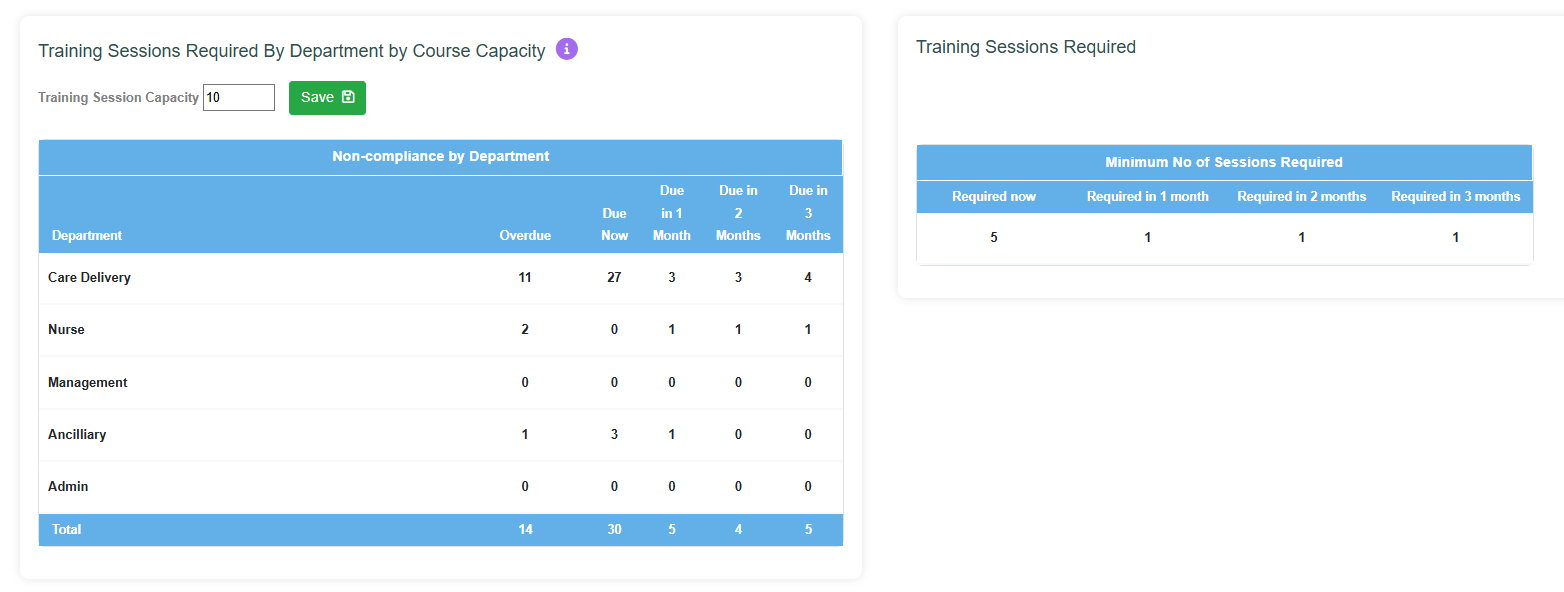
You also need to figure out how many people from different departments you can release in one go and hence how many training sessions you need to arrange for each particular training course.
This requires planning in advance and communication with departmental managers and getting these sessions booked into rotas to ensure those requiring the training are free.
With this level of complexity it's easy to see why many providers struggle to ensure their staff receive the training they need.
This is a full-time job.
Why Traditional Methods No Longer Work
Spreadsheets, individual staff files, sticky notes and scattered booking emails simply can't keep pace with the volume and complexity of modern care training requirements.
These traditional methods fail for three main reasons:
- 1. Constant Movement
- 2. No Real-Time Visibility
- Who is overdue
- What's already booked
- Which courses expire next
- Who needs what based on their role
- 3. No Bigger Picture Oversight
- Time-consuming
- Prone to mistakes
- Difficult to keep updated
- Impossible to scale
- Who is compliant
- Who is overdue
- Who is already booked
- What steps you are taking to stay compliant
- Completed courses
- Renewals due
- Overdue items
- Role-specific requirements
- Compliance
- Click this link - Training Matrix Features - if you'd like to see more.
- Click this link - Get Started - if you want to jump straight in, sign-up and start your free 30-day trial - all the features available and free to try.
- Click this link - Book a demo - and see the Training Matrix in action.
To do that you need all responsible for rota management to have this forward visibility and work with whoever is responsible for booking training.
You also have new staff joining, others leaving and some changing roles, including some who will be new to managing rotas and training requirements.
A spreadsheet can't adapt quickly enough.
This wastes hours every week.
This is when errors happen, where training gets missed and the numbers of those due builds and builds as does the loss of control, stress and cost.
To summarise, traditional methods are:
And when CQC arrives, missing just a few overdue courses - or being unable to evidence actions taken - can impact your rating.
You Need a Training Management System That Works
So, having outlined just how hard it is to keep on top of all the training your staff require, you'd like to think that I have an answer.
I do.
Introducing our new training management tool - the Training Matrix. The Training Matrix has been designed specifically to solve these challenges.
It gives you one simple system where all training requirements, due dates, compliance levels and upcoming needs are visible at a glance.
The Training Matrix is Your Central Hub for Training Compliance
Key Benefits
✔ Instantly see who's compliant and who's overdue - From a top-level organisation compliance view for each course, to a departmental view, to individuals, the Training Matrix will show you what you need to know to ensure compliance.
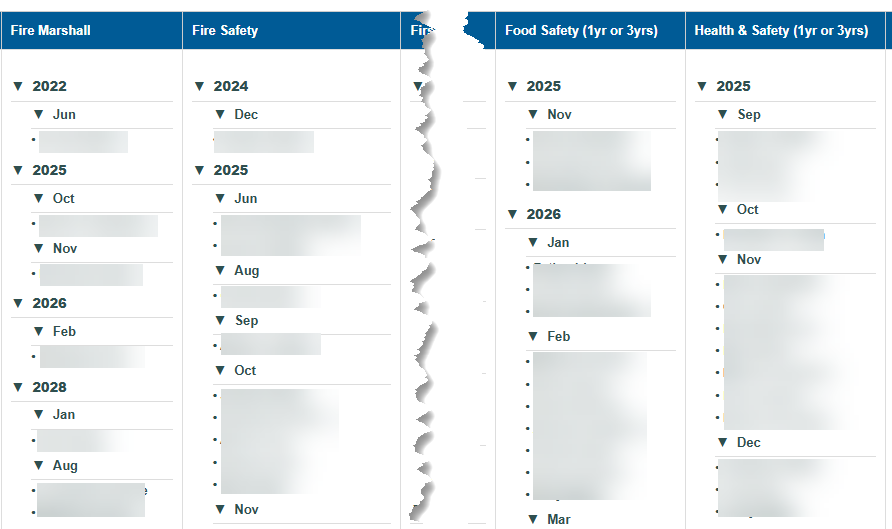
As well as seeing who is due what training by department, you can also see who is due training, across all departments for a particular course.
When people are booked on, their names will disappear from this list, so you don't have to go to another part of the tool to check if they have been booked on.
As training is received or booked the dashboard will automatically update your compliance figures.
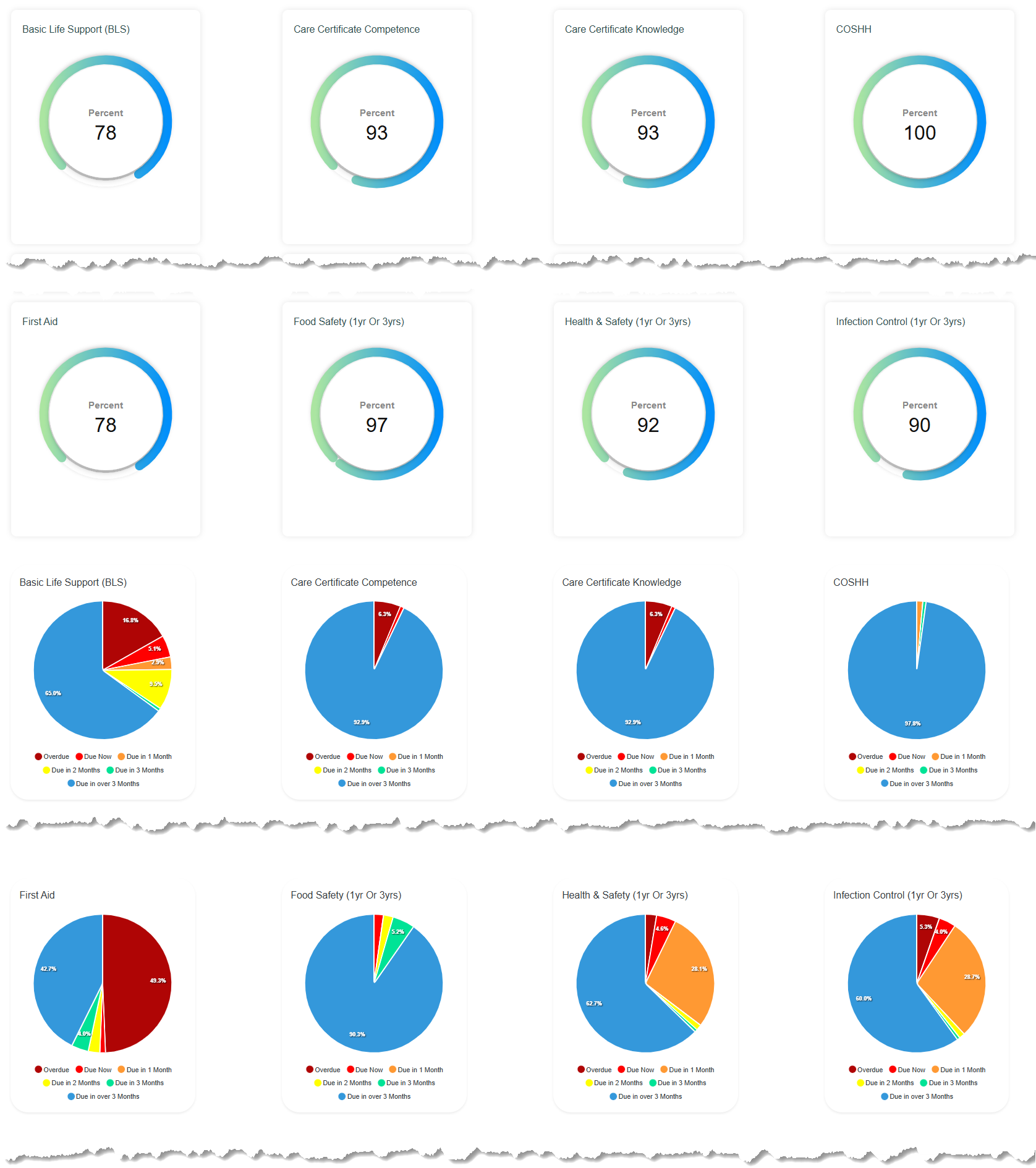
✔ Track hundreds (or thousands) of training items without stress - Whether you have 10 staff or 150, the Training Matrix scales effortlessly.
✔ See an individual staff member's entire training history instantly - No more searching through files — one click shows:
You even get a risk factor based on compliance of the core mandatory course.
This is such a powerful feature. Imagine, an inspector requests to see a particular person's training status and it's there, automatically in a click. No more stress and wasted time digging out the person's file, searching for the evidence and hoping it doesn't show their training is out of date.
Internally, this will help managers with supervisions. They will instantly see where their staff member is compliant and more importantly not compliant with their training and if they are actually safe to be delivering care for example.
✔ Multiple user access - All relevant departmental managers can have user access to the Training Matrix and see at a glance who of their people need to be booked onto a training session.
Transform Stress and Hard Work into Simplicity and Efficiency
We tested the Training Matrix on our sister company's three nursing homes. That's around 450 staff the tool has been tested on. That helped iron out any missed issues and gave us suggestions - like the individual person's report - to make it that much better.
Julie, the training manager for the three sites genuinely loves it.
Here's what she said…
"As a Training Manager overseeing training across three care settings, the new Training Matrix has been a game-changer. It streamlines processes, provides clarity for every role, and gives us the insights to act before issues impact service delivery. The individual staff report is a standout — it helps line managers surface and fix compliance issues fast, making supervisions far more effective."
Julie also loves the fact that other managers can have their own log in details and access the Training Matrix.
I am absolutely confident that the Training Matrix will transform the management of your training needs from a long, stressful, complex management task to a simple, efficient system that all managers can take ownership of and keep all in your organisation well-trained and compliant.
If transforming your training management in the way I've described appeals to you then here are your next step options:


Products

Home Care Fee Calculator