Strengthen Where You Are Before You Chase Where You Want To Be

September can feel like a second New Year. The summer holidays are ending, schools are going back and there is a renewed sense of energy. It's natural to start thinking about what you want to achieve over the coming months.
Before you chase where you want to be, strengthen where you are.
In my last post, Don't Jump Straight Back In: What Is Your Care Business Telling You?, I encouraged you not to return from your summer break and immediately disappear back into the day-to-day.
Instead, I suggested you use any fresh perspective you gained from your time away to then step back on your return and take an honest look at where your business is today.
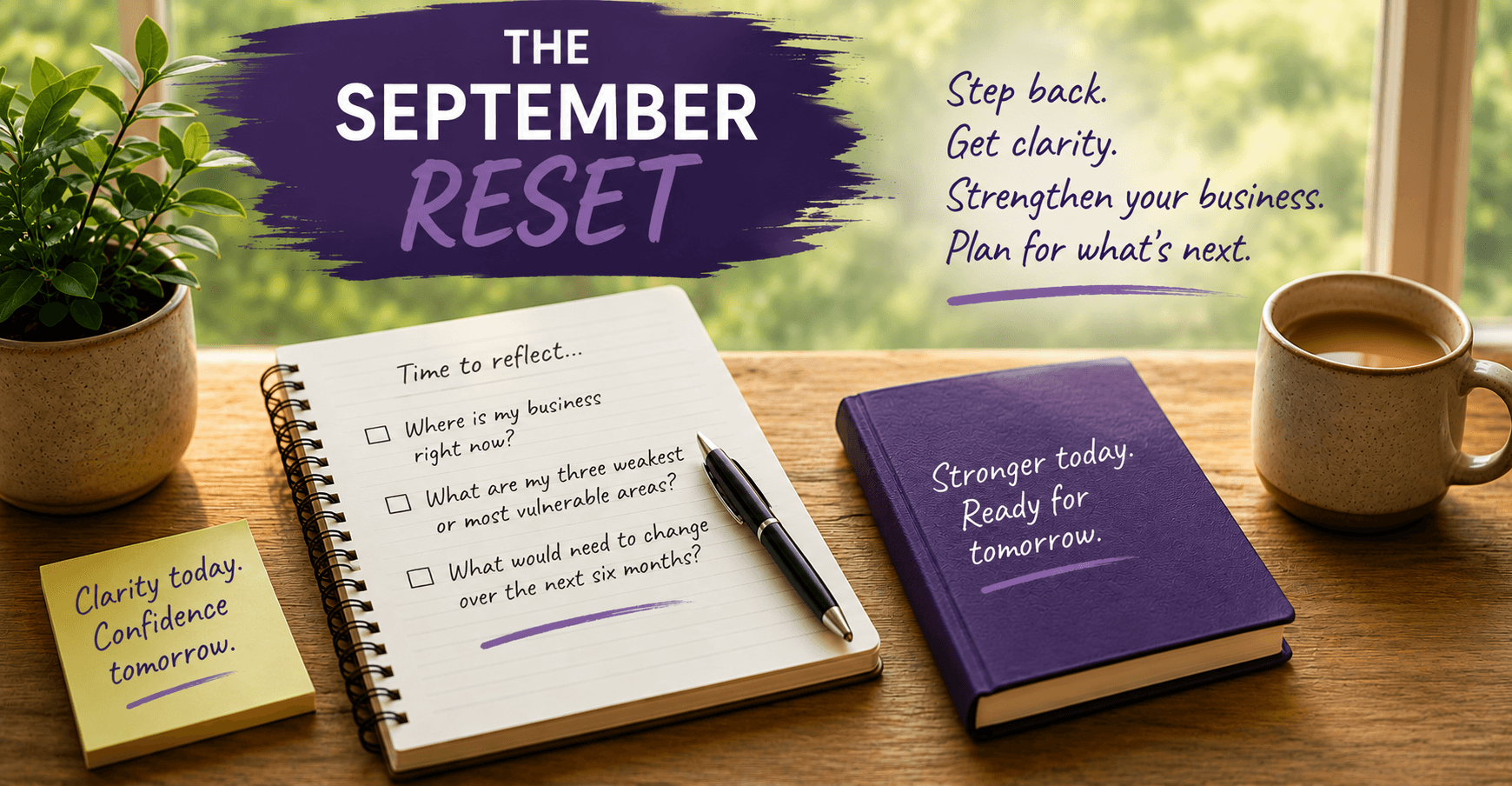
In particular, I asked you to identify three areas of your business that concern you most and then ask:
- Why does this concern me?
- What evidence do I have?
- What would need to change for me to feel confident about this area six months from now?
If you haven't worked through that exercise yet, I would suggest reading the previous post before continuing with this one: Read: Don't Jump Straight Back In: What Is Your Care Business Telling You?
Because this time we're going to take the next step.
From clarity to action
September can feel like a second New Year. The summer holidays are ending, schools are going back and there is a renewed sense of energy. It's natural to start thinking about what you want to achieve over the coming months.
Maybe you have returned with new ideas, new projects to drive the business forward. Perhaps a new service, more clients, higher occupancy or increased care hours.
All exciting ambitions that you will naturally want to expand on an execute after you holiday. But before you start adding more, look again at the three areas you identified in our first exercise.
Why? Why identify your weak or vulnerable areas? Because it will give you clarity about what isn't working well and be able to decide what you're going to do about it.
Why should this be your priority over focussing on exciting new growth ideas?
Well… What would happen if you achieved your new goals without fixing those weaknesses first?
- If your systems are already struggling, what happens when you add more clients?
- If you don't have enough management visibility now, what happens as the business grows?
- If your fees aren't covering your true costs, what happens if you win more work at the same inadequate rate?
- If too much depends on one person today, what happens when their workload increases?
Growth doesn't automatically solve weaknesses. Sometimes it magnifies them.
So, before you chase where you want to be, strengthen where you are.
Start with the three areas you identified
Go back to your three concerns from the first exercise.
For each one, write down:
What is wrong or happening now?
Be specific. Don't write “our systems aren't good enough”. What actually isn't working?
Why is it happening?
Try to get beyond the symptom. If something keeps going wrong, what is allowing it to happen?
What does good look like?
If you fixed this properly, what would be different?
What needs to change?
What practical actions would move you from where you are now to where you need to be?
Who needs to own it?
Improvement needs accountability.
How will you know it has improved?
What information, measure or result will tell you that the change has worked?
When will you review it?
Put a date against it. Otherwise, today's improvement priority can very quickly become tomorrow's forgotten good intention.
You have now started turning the concerns you identified in the first exercise into a practical improvement plan.
Then widen the review
Your three concerns are the obvious place to start because they are the issues already demanding your attention.
But they may not tell you everything.
As we discussed in the last post, sometimes the greatest vulnerability is something you cannot yet see.
So, once you have worked through your three immediate concerns, take a slightly wider look at the business.
Use four lenses:
Financial Health. Strategy. Systems. Leadership.
These four areas will help you test whether there are other weaknesses you need to understand before deciding on your priorities for the months ahead.
1. Check your financial health
Everything starts here.
You can have ambitious plans, a committed team and an excellent reputation, but if the underlying business isn't financially sustainable, your choices become increasingly restricted.
Ask yourself:
- Do you know your true operating costs?
- Are you monitoring actual spend against budget?
- Are your fees keeping pace with your costs?
- Do you know which placements or care packages are profitable?
- Can you evidence the fees you need?
- Are there financial warning signs that you are tolerating rather than addressing?
Financial health creates choices. It gives you the ability to invest, recruit, train, improve and grow.
And, importantly, it gives you greater independence over the future of your business.
2. Review your strategy
Next, ask whether you and your people know where the business is going.
What are you trying to achieve over the remainder of the financial year?
What does success look like? What needs to improve?
And what are you deliberately not going to do?
Strategy is as much about deciding where not to spend your time as deciding where to spend it. Your strategy for the next six months may quite reasonably place greater emphasis on strengthening the business so that your future growth plans have a better chance of succeeding.
Don't overwhelm yourself – just choose a small number of things that genuinely matter.
We'll look at those priorities in more detail later this month.
For now, ask whether the direction is clear.
3. Look for weak systems
This is an area that is easy to overlook because weak systems often hide behind good people. Things appear to work because somebody knows what needs doing.
Which is great until that person leaves, goes off sick, gets overwhelmed or simply stops doing it.
Then you discover that what you thought was a system - a part of your business that worked - was actually a dependency.
Look around your business for:
- recurring mistakes
- duplicated work
- information held by one person
- important spreadsheets nobody else understands
- processes that aren't documented
- things you only discover when they go wrong
- repeated firefighting
- reports that tell you what happened weeks ago rather than what is happening now
Every one of these is a clue.
Good systems should create clarity, consistency and control — and free your people to spend more time doing the work that actually matters.
And good systems reduce your dependency on any single individual. I confess I have been caught out by this in the past. I had become too dependent on one person and their expertise, which allowed me to focus my attention elsewhere.
Until that person handed in their notice.
I then had to understand that part of the business very quickly. My team and I also discovered work that had not been completed as it should have been, and we spent weeks correcting problems that should have been visible much earlier.
I learned the hard way that relying on a capable person is not the same as having a reliable system. I vowed that I would never allow one part of the business to become so dependent on one individual again.
4. Look at leadership and accountability
Finally, look at how the business is being led.
- Are expectations clear?
- Does everyone know what they are responsible for?
- Are the right things measured?
- Do managers report consistently?
- When something starts going wrong, how quickly do you know?
And perhaps most importantly:
Where in the business are you relying on reassurance rather than evidence?
“I think we're on track.”
“Everything's okay.”
“We're dealing with it.”
Those statements may all be true. But strong leadership needs visibility.
Not because you don't trust people, but because good information enables people at every level to manage better.
Have your three priorities changed?
Now return to the three concerns you started with.
Having reviewed Financial Health, Strategy, Systems and Leadership, are they still the right three — or has the wider review revealed something more fundamental?
What appeared to be a staff-performance problem may actually be unclear leadership or accountability.
What appeared to be overspending may be caused by poor financial visibility or weak budget ownership.
Repeated mistakes may reveal the absence of a reliable system rather than several individual failures.
You may keep your original three. You may redefine one or more of them. Or you may replace something with a more important weakness uncovered through this review.
Don't simply fix the symptom. Strengthen the underlying weakness.
Once you are confident that you have identified the right three areas, use the questions from earlier to turn each one into a practical improvement plan.
Strengthen your foundations for growth
There is a natural temptation in business to concentrate on growth. But I hope you see now how growth can amplify weaknesses as easily as strengths.
So before asking: How can we grow?
Ask: What needs strengthening so that we are ready to grow?
Strengthening your business will build the strong foundation it needs to then achieve your ambitions. It really is worth doing.
Give yourself a stronger starting point
There are seven months between September and the end of the financial year, which is plenty of time to make a meaningful difference to your business.
- Improve financial visibility.
- Fix a weak system.
- Clarify accountability.
- Resolve something that keeps causing problems.
- Remove a dependency.
- Address a training gap.
- Get better information.
Then, when you decide what you want to achieve over the next seven months, you will be starting from a much stronger position.
Coming soon: The September Reset Guide
We are also creating a free practical Guide to help you work through your own September Reset.
It will bring together the questions and exercises from this series, helping you step back, identify what needs strengthening and turn your thinking into a clear plan for the months ahead.
Look out for more details later this month.
Once you have confirmed the three areas that need strengthening, you will be ready for the next stage: deciding what matters most between now and 31 March.
In the next article, we'll look at how to turn what you have uncovered into three clear priorities for the remainder of the financial year — including what success looks like, how progress will be measured and what you will deliberately not prioritise.
Strengthen where you are before you chase where you want to be. Your future plans will have a much better chance of becoming reality.


Products

Home Care Fee Calculator