You Can't Fix Everything: Choose What Matters Most

In the last article in our September Reset series, Strengthen Where You Are Before You Chase Where You Want To Be, we took a good look under the bonnet of your care business.
I asked you to identify the three areas that concern you most and then test the wider business through four lenses:
Financial Health. Strategy. Systems. Leadership.
The purpose was to uncover what really needs strengthening — rather than simply dealing with the problems making the most noise.
If you've worked through that exercise, you should now have a much clearer picture of where your business is strong, where it is vulnerable and what needs to change.
Now comes the difficult bit.
Where should you focus your time and effort? You can't fix everything and trying to usually means you don't fix anything particularly well.
Before we look at that, bear in mind…
A weakness isn't automatically a priority
Your review may have uncovered (or will if you haven’t yet done it) quite a few things you'd like to improve.
- Perhaps your financial visibility isn't good enough.
- Maybe you've discovered an important process that depends too heavily on one person.
- You might need clearer management accountability, better training compliance, stronger reporting or more effective systems.
All of those may be important. But they can't all be your number one priority.
So now we need to make some choices.
Ask yourself:
If we could make significant progress in only three areas between now and 31 March, which three would make the biggest difference to the strength of this business?
How do you decide what matters most?
I would test each potential priority against four simple questions.
1. What happens if we do nothing?
Doing nothing is not a neutral decision but rather a business-harming decision.
If you leave an issue untouched for another six months, what happens?
- Does the financial risk increase?
- Does the business become more dependent on one person?
- Could it create a compliance problem?
- Will it continue consuming management time?
- Could it prevent you achieving something else?
The greater the consequence of doing nothing, the higher it probably needs to sit on your list.
What difference would fixing it make?
Now look at the other side. If you fixed this properly, what would it mean to you and your business?
- Would you have better financial control?
- Would managers take greater ownership?
- Would you reduce firefighting?
- Would you free up your own time?
- Would you be able to grow with greater confidence?
- Would you sleep a little better at night?

Also, to help identify where to focus your attention, think about how many potential problems an improvement solves. If several, then that is worth paying attention to and should be on your short list.
For example, if you struggle to keep on top of the training needs of your people, fixing that by investing in a training management system, such as the Training Matrix, could solve potential issues like compliance, quality of care being delivered, safeguarding, confidence and motivation and staff conflict.
3. What else depends on it?
This is particularly important.
Some things need fixing before other things can happen.
There's little point aggressively increasing occupancy if you're already struggling with staff capacity or low fees.
Sometimes the best priority isn't the exciting thing you want to achieve but the foundation you need to put in place before you can achieve it safely.
4. Can we genuinely do something about it?
Finally, be realistic.
Do you have the people, time, money and authority needed to make meaningful progress?
If not, what would have to change first?
There's no point filling a plan with worthy ambitions nobody has the capacity to deliver.
Three priorities that actually happen are considerably more valuable than ten that sit on a spreadsheet.
Now define what success looks like
Once you've chosen your three, make each one specific.
Don't write: Improve our systems.
Write what will actually be different.
Don't write: Improve profitability.
Define what improvement you're looking for.
Don't write: Managers need to take more responsibility.
Describe what you expect them to own and how you'll know it's happening.
For each priority, complete this sentence:
By 31 March, we will...
Then decide:
- What will success look like?
- How will we measure progress?
- Who owns it?
- What are the first actions?
- When will we review progress?

This gives you a structured plan to help you execute the improvement strategy you have developed.
Just as importantly — what won't you prioritise?
This is the bit that often gets missed.
Every time you say yes to one priority, you're effectively saying no — or at least not yet — to something else.
You are being strategic in what you are going to focus on AND equally what you are not going to focus on yet.
There will always be more good ideas than there is time to deliver them. So, alongside your three priorities, create a Not Now list.
These aren't bad ideas. They're things you've consciously decided not to allow to distract you from what matters most right now.
You can revisit them later. But for the moment, protect your three priorities.
Seven months is enough time
There are around seven months between September and the end of the financial year. That's a meaningful amount of time.
- You could fix an important system.
- Build much better financial visibility.
- Reduce a dangerous dependency.
- Develop stronger managers.
- Improve training compliance.
- Put proper accountability in place.
- Or finally resolve something you've tolerated for far too long.
You don't need to transform the entire business by 31 March.
But imagine how much stronger it could be if you genuinely improved the three things that matter most.
The September Reset Guide
We've now brought the whole September Reset process together into a free practical guide.
The September Reset Guide is designed to give you the thinking space and structure to step back from the day-to-day, look objectively at your business, identify what needs strengthening and decide what deserves your attention over the months ahead.
It takes you through the exercises from this series so you can work through your own Reset rather than simply read about one.
So, if you haven’t read the previous post, Strengthen Where You Are Before You Chase Where You Want To Be, please do and use The September Reset Guide to help you.
Download your free copy of The September Reset Guide and identify the three priorities that could make the biggest difference to your business by 31 March.
Because running a stronger business isn't about trying to improve everything at once.
It's about knowing what matters most — and making sure it actually happens.
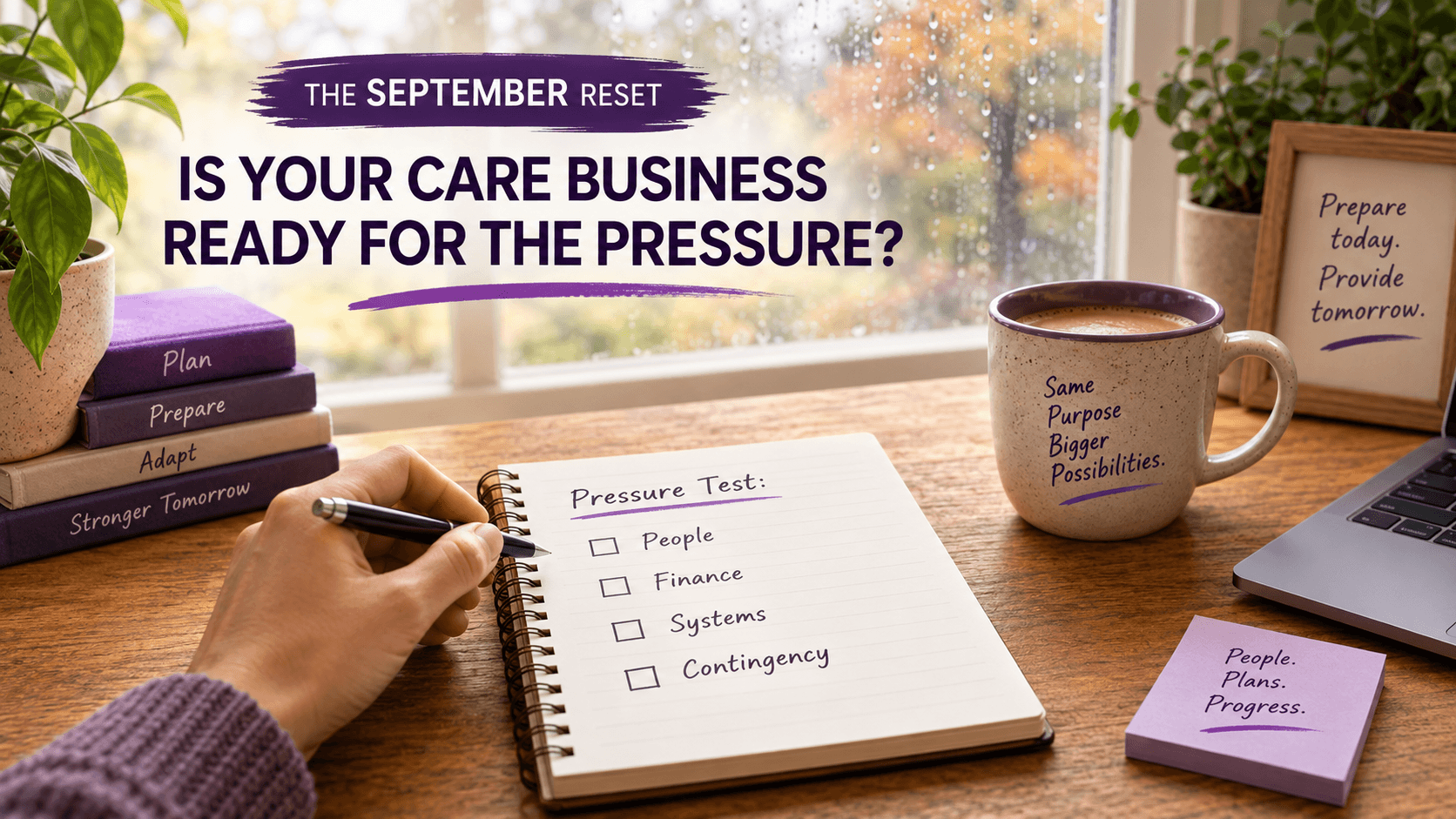
Next: Are you ready for the pressure?
Once you've decided what matters most, there's one more useful test.
What happens when your business comes under pressure?
As we move towards winter, that's exactly what we'll look at in the final part of the September Reset series.


Products

Home Care Fee Calculator