Take Time Out This Christmas to Think About the Year Ahead

After all the rushing around and the hullabaloo of Christmas, the quieter days between Christmas and New Year could be the perfect time to reflect on the year gone and to think about the year ahead.
What worked well and what didn’t in 2025?
This is a good question to start with and often it is easier to look at what didn’t work well because these are the areas that will have stressed and frustrated you throughout the year and possibly stopped you from having the year you wanted.
Identify the top two or three areas that didn’t work, based on the impact on you and your business and write each on a piece of paper.
I like to use A3 sheets of paper for this and, having identified a challenge or weakness in my business or a threat to it, I simply map out the problem and possible solutions.
I write the challenge in the centre of the paper and then branch off with more detail about the challenge and impact on me and my business then branch off those items with possible causes and branch off from those with possible solutions.
Doing this will not only help you gain valuable insights into the strengths and weaknesses of your business, but it will also help you see how to improve those areas. You may find that the root of the problem may actually be different from what appears obvious.
For example, you may have an underperforming manager who’s lack of achieving has a knock-on effect on staff and the smooth running of the business.
But delve deeper and you might discover that this manager’s behaviour isn’t because they have a crappy attitude but because they are overworked and stressed because they aren’t receiving the support they need from their manager, or possibly even from you because you are too busy resolving issues and trying to keep your head above water.
Maybe this person is the manager of the care team, and the carers are making too many mistakes - which this person is constantly having to address - because they aren’t receiving the training they need. Or maybe staff turnover is too high and this manager is too often having to arrange training for new staff and be a mentor to them.
This person may have the potential to be the best care manager ever, but the business simply doesn’t work well enough to allow them to achieve and shine.
Let’s say one of the causes is poor training. Why aren’t staff receiving the training they need?
- Is it a cost issue? Have you had to pull back on essential training because your business is struggling financially?
- Is it because you don’t have an effective training management system in place that tells you when training is due for each staff member and so they don’t receive refresher training needed?
If the former, then are your costs too high and your fees too low to return the profit your business needs to invest in areas like training?
If the latter, then you need to establish a system that will keep your people trained and compliant. If you don’t have such a system then check out our Training Matrix tool.
You see how what started with the challenge of a ‘poor manager’ and the obvious solution to manage out, was actually an issue with a lack of training due to either because of financial pressures or the lack of a decent training management system.
Address Your Top Challenges
Having identified specific areas that require improvement and delved down to find their root causes, you will probably find common causes that, if addressed, will fix a number of these issues.
For example, the root cause of many issues can boil down to the financial health of a business.
As this image highlights, delivering a consistently good service costs money. Especially in this sector where staff costs are such a large proportion of overall costs.
Your top aim is to deliver the care your clients need and so your top priority must be to make your care business financially healthy enough to be able to deliver that service.
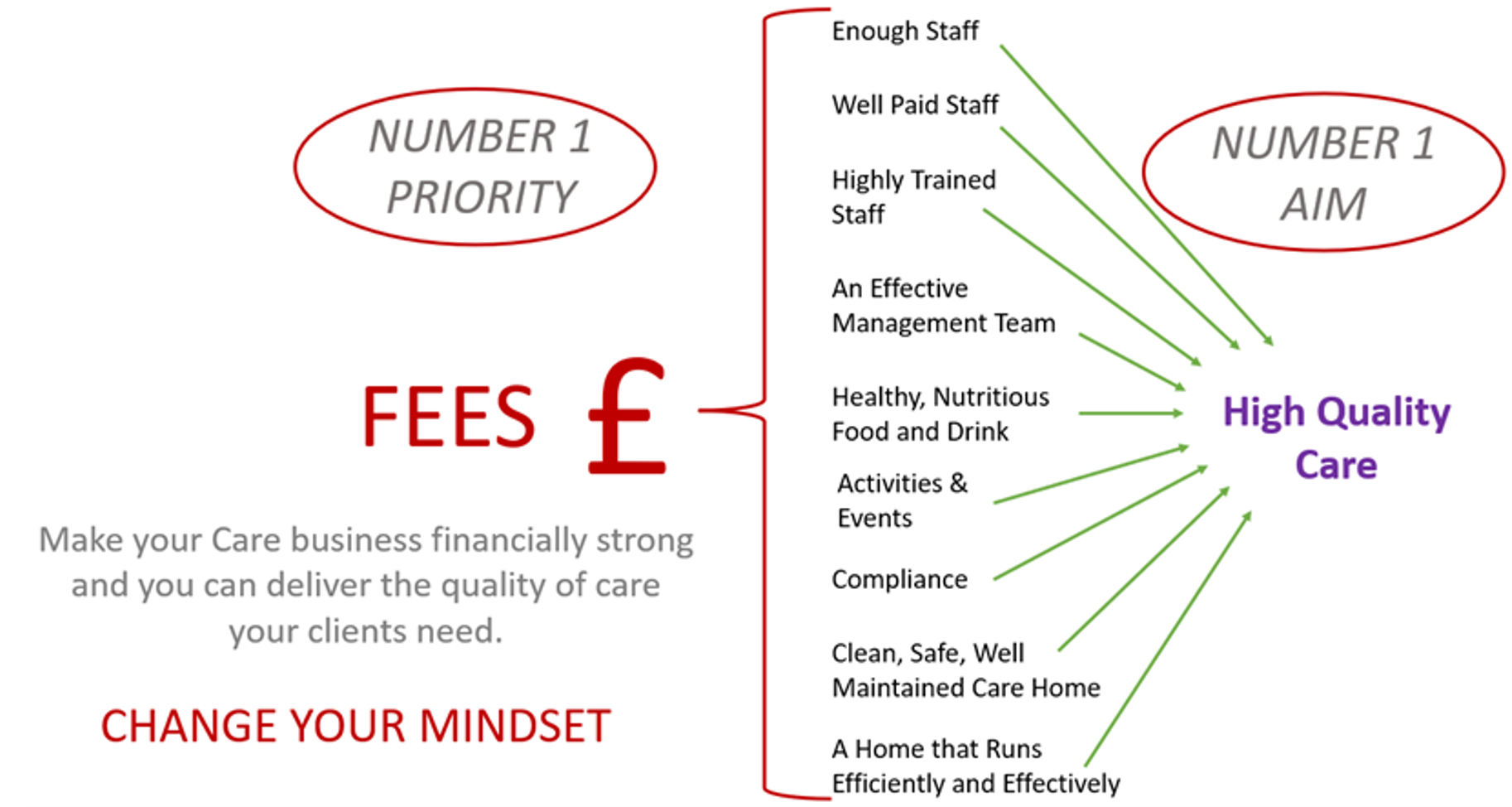
This means you need to receive the fees needed to cover your costs and return the essential profit needed to invest back into your business and address issues like high staff turnover with competitive pay and quality training.
The result will be a better service, fewer mistakes and that care manager above being able to be the brilliant manager you need so you can step back from working in your business to start working on it.
Being financially healthy is the biggest challenge for most care providers and without doubt the top priority to address if your business isn’t as financially strong as it needs to be.
Nothing you do to improve your service will last if you are struggling financially. Over 90% of care homes that closed over the last decade did so ‘voluntarily’. That means the owners made the decision to close because they ran out of money and the vast majority of these were rated ‘Good’ by CQC.
If this is a concern then please download my free report 5 Steps to Make Your Care Business Financially Secure.
I update this report each year, showing the impact of April’s cost rises. Hence, even though the numbers will be out of date, the messages and the steps I take you through to setting and receiving the right fees is valid.
With the rises in NLW, NMW and NICs last April, most care providers saw a cost increase of at least 10%. If they didn’t increase their fees to cover this cost, as many didn’t, this equated to that much lost profit. And now, looming on the horizon, are new increases in NLW and NMW.
As, your staff costs are by far your greatest cost, you cannot afford to soak up these further increases and instead need to know exactly what this increase will do to your business so you can prepare for it.

My report will show you how.
5 Steps to Make Your Care Business Financially Secure
And if you are receiving fees that are too low then start to review these fees as soon as you can next year because if you do need to increase your fees (and you will), you know that your local authority or ICB quite rightly won’t simply accept what you are saying. And arranging client reviews meetings will take time.
When you review your fees, do it based on your current costs so you know where you are now. Then repeat the exercise based on what you think your costs will be after April’s cost rises.
I made a mistake last year – I promoted our Care Fee Calculator software tool as, “The fee calculator your commissioners won’t want you to have.” When I gave talks on financial viability, more than one person from the local authority responsible for commissioning told me that this was exactly the kind of tool they wanted you to have.
They struggle to increase fees for a provider who says they need say, £300 a week more for a client but can’t present an accurately calculated fee and hence the evidence that justifies the need for that fee increase.
Coming to them with a detailed fee showing running costs that need to be covered, and care calculated using an accurate average hourly rate for carers (and nurses) that includes extra employer costs, is exactly what they want so a useful discussion can take place.
Conclusion
In the fast-paced world of business, taking the time to intentionally plan for the future is a strategic advantage.
Use the end of this year to reflect and identify what you need to do to take your care business forward and especially to eliminate the big challenges you have faced this year and will face next if not addressed.
By actively shaping the future you desire, you position your company for success and create a roadmap for growth, resilience, and lasting positive change.
Don't just hope for a better year—make it happen.


Products

Home Care Fee Calculator